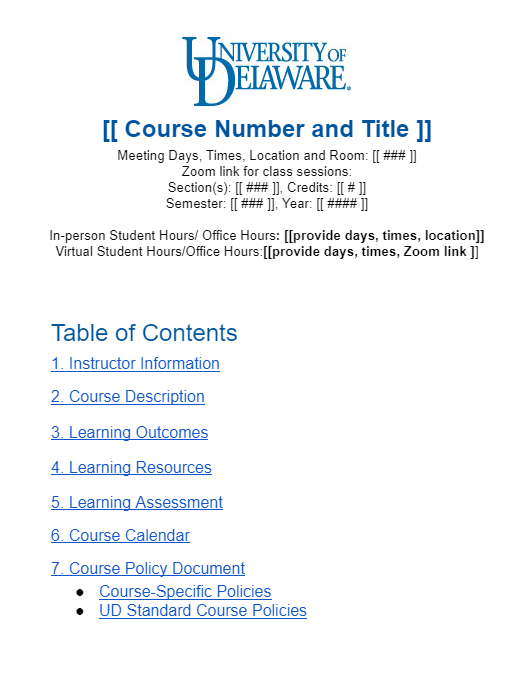
 |
Designing
a Learning-Centered Syllabus |
For additional hints on syllabus design, see also the tipsheet, "Components
of a Learning-Centered Syllabus".
Designing learning objectives:
Angelo, T., & Cross, P. (1993). Online teaching goals inventory . Center for Teaching, University of Iowa.
Click on "take the T.G.I" on the left side of the screen .
Suggested syllabi statements that address issues of academic integrity , University of Delaware, Office of Judicial Affairs.
Sample online syllabi (problem-based learning) , University of Delaware, Institute for Transforming Undergraduate Education.
"How to Integrate
Students' Learning Objectives into the Syllabus Design" describes how
a faculty member has incorporated syllabus discussion into his class.
Publishing your syllabus on the web , University of Delaware, IT-User Services.
Highlights
from:
Grunert, Judith (1997) The Course Syllabus: A Learning-Centered
Approach.
Bolton, Massachusetts: Anker Publishing Company, Inc.
Available in the CTE Library, 212 Gore Hall.
Your syllabus can be an important point of interaction between you and
your students, both in and out of class. The traditional syllabus is primarily
a source of information for your students. While including basic information,
the learning-centered syllabus can be an important learning tool that will
reinforce the intentions, roles, attitudes, and strategies that you will
use to promote active, purposeful, effective learning.
Suggested Steps for Planning Your Syllabus:
-
Develop a well-grounded rationale for your course
-
Decide what you want students to be able to do as a result of taking your
course, and how their work will be appropriately assessed
-
Define and delimit course content
-
Structure your students’ active involvement in learning
-
Identify and develop resources
-
Compose your syllabus with a focus on student learning
Suggested Principles for Designing a Course that Fosters Critical Thinking*
:
-
Critical thinking is a learnable skill; the instructor and peers are resources
in developing critical thinking skills.
-
Problems, questions, or issues are the point of entry into the subject
and a source of motivation for sustained inquiry.
-
Successful courses balance the challenge to think critically with support
tailored to students'’developmental needs.
-
Courses are assignment centered rather than text and lecture centered.
Goals, methods and evaluation emphasize using content rather than simply
acquiring it.
-
Students are required to formulate their ideas in writing or other appropriate
means.
-
Students collaborate to learn and to stretch their thinking, for example,
in pair problem solving and small group work.
-
Courses that teach problem-solving skills nurture students’ metacognitive
abilities.
-
The developmental needs of students are acknowledged and used as information
in the design of the course. Teachers in these courses make standards explicit
and then help students learn how to achieve them.
Syllabus Functions:
-
Establishes an early point of contact and connection between student and
instructor
-
Helps set the tone for your course
-
Describes your beliefs about educational purposes
-
Acquaints students with the logistics of the course
-
Contains collected handouts
-
Defines student responsibilities for successful course work
-
Describes active learning
-
Helps students to assess their readiness for your course
-
Sets the course in a broader context for learning
-
Provides a conceptual framework
-
Describes available learning resources
-
Communicates the role of technology in the course
-
Can expand to provide difficult-to-obtain reading materials
-
Can improve the effectiveness of student note-taking
-
Can include material that supports learning outside the classroom
-
Can serve as a learning contract
Checklist for a learning-centered syllabus:
-
Title Page
-
Table of Contents
-
Instructor Information
-
Letter to the Student
-
Purpose of the Course
-
Course Description
-
Course and Unit Objectives
-
Resources
-
Readings
-
Course Calendar
-
Course Requirements
-
Evaluation
-
Grading Procedures
-
How to Use the Syllabus
-
How to Study for This Course
-
Content Information
-
Learning Tools
*Cited
in Kurfiss, J. G. (1988) Critical thinking: Theory, research, practice
and possibilities. ASHE-ERIC Higher Education Report No. 2. Washington,
DC: Association for the Study of Higher Education.
 |
Components
of a Learning-Centered Syllabus |
Highlights
from:
Altman & Cashin. (1992). Writing a syllabus.
IDEA Paper No. 27. Kansas State University. Graeber/Harris
Communications & Productions, Inc. (1995). First day.
Grunert, J. (1997). The course syllabus.
A learning-centered approach. Bolton, MA: Anker Publishing.
Course Information:
-
What do students need and/or want to know about the course?
-
What pre-requisites exist?
Instructor Information:
-
What do I want students to know about myself? My interest in the discipline?
My teaching philosophy?
-
How can I convey my enthusiasm for teaching, for the course?
-
Other instructors in the course (e.g., graduate TAs, peer tutors, team
teacher)?
Course Description:
-
What content will the course address? How does the course fit in with other
courses in the discipline? Why is the course valuable to the students?
-
How is the course structured?
Large lecture with discussion sessions? Large lecture with laboratory
and discussion sessions? Seminar?
-
How are the major topics organized?
Course Objectives:
-
What will the students know and be able to do as a result of having taken
this course?
-
What levels of cognitive thinking do I want my students to engage in?
-
What learning skills will the students develop in the course?
Instructional Approaches:
-
Given the kind of learning I'd like to encourage and foster, what kinds
of instructional interactions need to occur?
Teacher-student, student-student, student-peer tutor?
-
What kinds of instructional approaches are most conducive to helping students
accomplish set learning objectives?
-
How will classroom interactions be facilitated?
In-class? Out-of-class? Online? Electronic discussion? Newsgroups?
Chatroom?
Course Requirements, Assignments:
-
What will students be expected to do in the course?
-
What kinds of assignments, tests do most appropriately reflect the course
objectives?
-
Do assignments and tests elicit the kind of learning I want to foster?
Assignments (frequency, timing, sequence)? Tests? Quizzes? Exams? Papers?
Special projects? Laboratories? Field trips? Learning logs? Journals? Oral
presentations? Research on the web? Web publishing? Electronic databases?
-
What kinds of skills do the students need to have in order to be successful
in the course?
Computer literacy? Research skills? Writing skills? Communication skills?
Conflict resolution skills? Familiarity with software?
Course Policies:
-
What is expected of the student?
Attendance? Participation? Student responsibility in their learning?
Contribution to groupwork? Missed assignments? Late work? Extra credit?
Academic dishonesty? Makeup policy? Classroom management issues? Laboratory
safety?
Grading, Evaluation:
-
How will the students' work be graded and evaluated?
Number of tests? In-class? Take-home? Point value? Proportion of each
test toward final grade? Grading scale?
-
How is the final grade determined? Drop lowest grade?
-
How do students receive timely feedback on their performance?
Instructor? Self-assessment? Peer review? Peer tutors? Opportunities
for improvement? Ungraded assignments?
Texts/Resources/Readings/Supplies:
-
What kinds of materials will be used during the course?
Electronic databases? Electronic Course Reserve? Course Webpage? Software?
Simulations? Laboratory equipment?
-
What kinds of instructional technologies will be used?
Course Calendar:
-
In what sequence will the content be taught? When are major assignments
due? Fieldtrips? Guestspeaker?
Study Tips/Learning Resources:
-
How will the student be most successful in the course?
-
What resources are available?
Online quiz generator? Study guides? Lecture notes online? Lecture
notes on reserve in library? Guestspeaker to explain/demonstrate online
resources? TA? Peer tutors? Study groups? Academic Services Center? Writing
Center? Evaluation of online resources? Citation of web resources?
Student Feedback on Instruction:
-
Anonymous suggestion box on the web? E-mail?
-
Student feedback at midterm for instructional improvement purposes?
-
End-of-term student feedback? Supplement to departmental student feedback
form?
Miscellaneous Information:
-
Instructor biography? Instructor personal statement? Student information
form? Other instructor information (e.g., TA)?
Additional questions to consider:
-
How detailed, explicit should the syllabus be?
-
Will there be some flexibility built into the syllabus?
-
How to word the syllabus so that it is user-friendly?
 |
Integrating
Students' Learning Objectives into Syllabus Design by William
H. Johnson Jr., College of Health and Nursing Sciences |
I teach HPER 167 (New Student Connections) and HPER 235 (Professional
Transitions) which are small classes (between 15 and 25 students) that
incorporate active learning strategies into teaching. One technique that
I find valuable is to distribute the syllabus during the second class period.
The first class period is used as an identification period, that is, students
(and myself) are asked to present a little background information about
themselves. Questions can be as routine as identifying name, hometown,
and birthdate, to more in-depth questions in attempts to get the students
to think about themselves by sharing their favorite music, hobbies and
activities, favorite TV shows and movies. I found that this ice-breaker
activity allows students to learn more about themselves, about others in
the class, and promotes an open exchange of information. I then take the
next few minutes to describe the course, general objectives I'd like the
students to achieve, and any basic information they may need for the next
class meeting.
During the second half of our first class meeting, the students work
on the following assignment: Name at least three topics--related
to the course description and objectives--that you would like to see addressed
in this class, then explain why these topics are important to you in pursuing
your future goals. By having the students work on this assignment,
I can get a sense of the depth of their thinking as well as topics that
they perceive are important to them (in addition to the topics I have already
planned), thus providing them with the opportunity to contribute to the
development and content of the course.
I tried this approach in the '98 Fall semester with freshmen students
enrolled in the HPER 167 course and the vast majority of the students felt
satisfied or extremely satisfied with the work required of them in class.
I will be implementing the same process in the HPER 235 course which mostly
consists of junior and senior students.
For more information on this instructional practice, contact William
H. Johnson, Jr.